Hardware Installation
How to fit the Kickstart Multi ROM with board revision 4 into your Amiga: opening the case, taking out the original Kickstart ROM, setting the OOPS Bug jumper for your motherboard, and plugging the carrier board into the ROM socket.
Table of contents
Find your motherboard
Board revision 4 comes on one carrier board for every supported Amiga: the Amiga 500, 500+, 600 and 2000. Its silkscreen says A500+/A600 and A500/A2000. What changes from one motherboard to another is the position of the OOPS Bug jumper, and it comes already set for the kit you ordered. Before You Buy explains how to read your motherboard revision.
| Computer | Motherboard | Kit | OOPS Bug jumper | ROM socket | Fitting the board |
|---|---|---|---|---|---|
| Amiga 500 | rev3, rev5 | A500 rev 3 and rev 5 / A2000 rev 4.2 or earlier | <= REV 5 | 40 pins | Amiga 500 |
| Amiga 500 | rev6a | A500 rev 6 / A2000 rev 4.3 or newer / A500+ / A600 | >= REV 6 | 40 pins | Amiga 500 |
| Amiga 500+ | all | A500 rev 6 / A2000 rev 4.3 or newer / A500+ / A600 | >= REV 6 | 42 pins | Amiga 500+ and Amiga 600 |
| Amiga 600 | all | A500 rev 6 / A2000 rev 4.3 or newer / A500+ / A600 | >= REV 6 | 42 pins | Amiga 500+ and Amiga 600 |
| Amiga 2000 | rev4.2 and earlier | A500 rev 3 and rev 5 / A2000 rev 4.2 or earlier | <= REV 5 | 40 pins | Amiga 2000 |
| Amiga 2000 | rev4.3 and later | A500 rev 6 / A2000 rev 4.3 or newer / A500+ / A600 | >= REV 6 | 40 pins | Amiga 2000 |
40-pin and 42-pin sockets
The Kickstart ROM socket is not the same size on every Amiga:
- The Amiga 500 and Amiga 2000 have a 40-pin socket, two rows of 20.
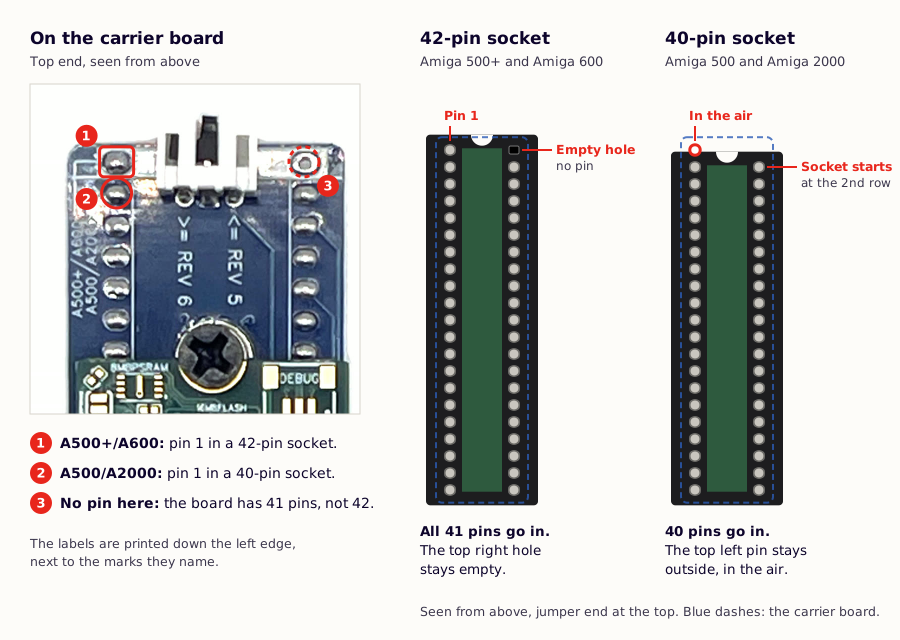
- The Amiga 500+ and Amiga 600 have a 42-pin socket, two rows of 21, made for 1 MB ROMs. Their original 40-pin Kickstart ROM sits in it with the pair of holes at the notch end left empty. The arrows printed on the motherboard next to the socket show where the chip starts.
One carrier board fits both. It has two rows of 21 positions, but only 41 pins: the top right position, next to the white jumper enclosure, has no pin, because no Amiga uses it. The top left pin is the extra one:
- In a 42-pin socket (Amiga 500+ and Amiga 600), the top left pin goes into the top left hole of the socket, pin 1, next to the notch. All 41 pins go in, and the top right hole of the socket stays empty.
- In a 40-pin socket (Amiga 500 and Amiga 2000), the top left pin stays outside the socket, floating in the air beyond the notch end. The other 40 pins go in, and the carrier’s second row lines up with the first row of the socket. That is expected and does not affect the installation.
“Top” here means the end of the carrier board with the white jumper enclosure, which always goes to the notch of the socket. In both cases the board works the same. The 42-pin socket also lets the Amiga 500+ and 600 use Kickstart images of up to 1 MB, an experimental feature: see Large ROMs.
The marks for each computer
Two marks are printed at the top of the carrier board, with the computers they are for written down its left edge:
- A box around the top left pin, labelled
A500+/A600: the pin that goes into pin 1 of the 42-pin socket of the Amiga 500+ and Amiga 600. - A triangle at the second pin on the left, labelled
A500/A2000: the pin that goes into pin 1 of the 40-pin socket of the Amiga 500 and Amiga 2000.
Find the mark for your computer, and put that pin into the hole next to the notch of the socket.
Opening the Amiga Case
Overview
Once the plastic case is removed, you’ll find a metal shielding that also needs to be taken off to reach the ROMs and other crucial parts of the computer. The user must remove both the plastic and metal casings to access the internal components safely. This process requires a few tools and safety precautions to prevent damage to the Amiga and ensure a successful installation of the Kickstart Multi ROM.
Tools Required
- Phillips-head screwdriver
- Flat-head screwdriver (optional, for prying)
- Anti-static wrist strap (recommended)
- Insulating tape
Safety Precautions
- Power Off and Unplug: Ensure the Amiga is powered off and unplugged from any power source before beginning the disassembly.
- Ground Yourself: Wear an anti-static wrist strap to prevent static electricity from damaging internal components. Alternatively, touch a grounded metal object periodically to discharge static electricity.
- Work on a Clean Surface: Use a clean, static-free workspace to prevent any debris or static discharge from interfering with the components.
Step-by-Step Instructions
- Remove the Screws of the plastic case:
- Turn the Amiga upside down and locate the screws securing the case.
- Using a Phillips-head screwdriver, carefully remove all the screws. Keep the screws in a safe place for reassembly. There are plenty of YouTube videos showing how to open an Amiga case.
- Separate the Case Halves:
- Once the screws are removed, gently separate the top and bottom halves of the case.
- If the case is difficult to open, use a flat-head screwdriver to carefully pry the halves apart, being mindful not to damage the plastic.
- Remove the Metal Shielding:
- After removing the plastic case, you’ll find a metal shielding covering the internal components.
- Locate the screws securing the metal shielding and remove them using a Phillips-head screwdriver.
- Also locate the secure tabs that hold the shielding in place and gently release them.
- Carefully lift the metal shielding off the Amiga to access the internal components.
- Locate the Amiga ROM:
- Once the metal shielding is removed, you’ll find the Amiga ROM chip.
- Depending on the Amiga model, they will be in different locations:
In the Amiga 500, the ROM is located at the left side of the motherboard between the Motorola 68000 CPU and the AGNUS chip. 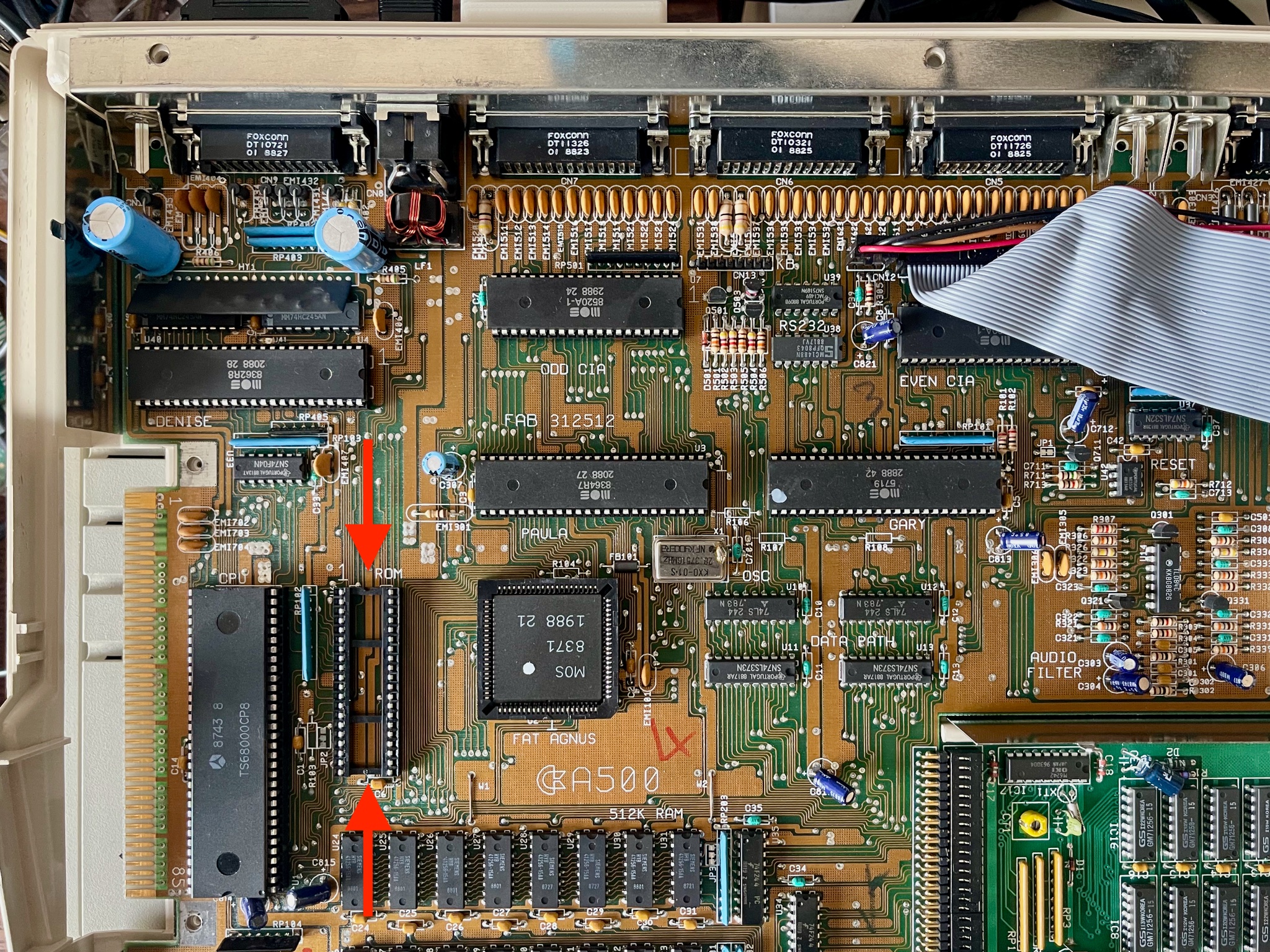
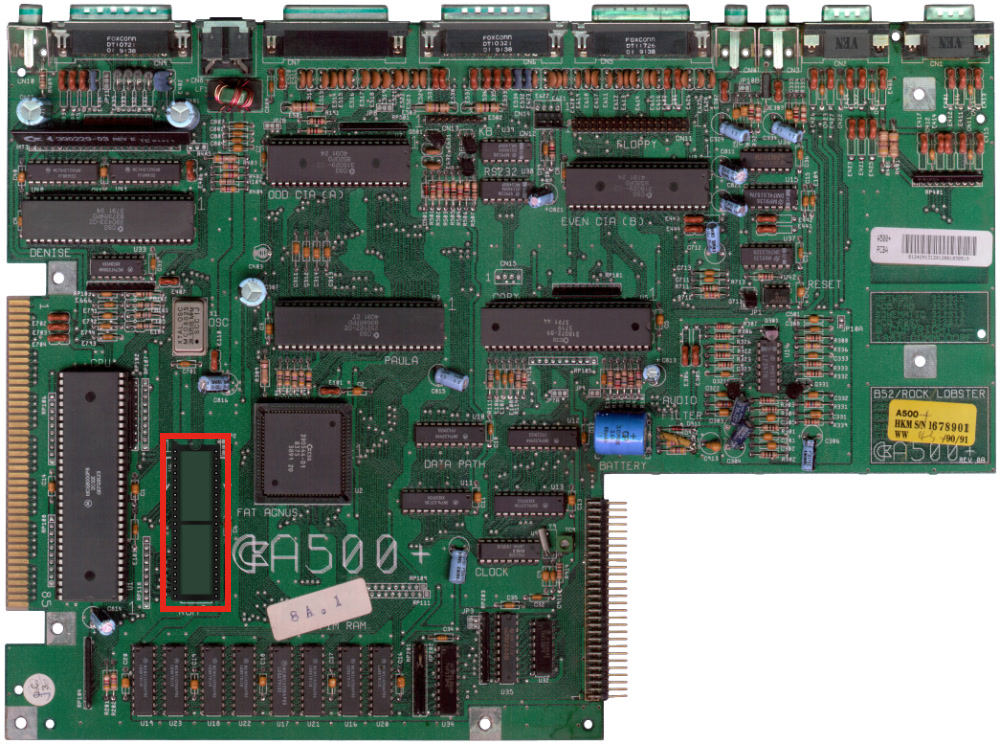
In the Amiga 500+, the ROM is at the bottom left of the motherboard, to the right of the Motorola 68000 CPU and below the AGNUS chip, marked ROM on the board.
In the Amiga 600, the ROM (U6) is at the bottom left of the motherboard, below the Motorola 68000 CPU and to the right of the PCMCIA slot.
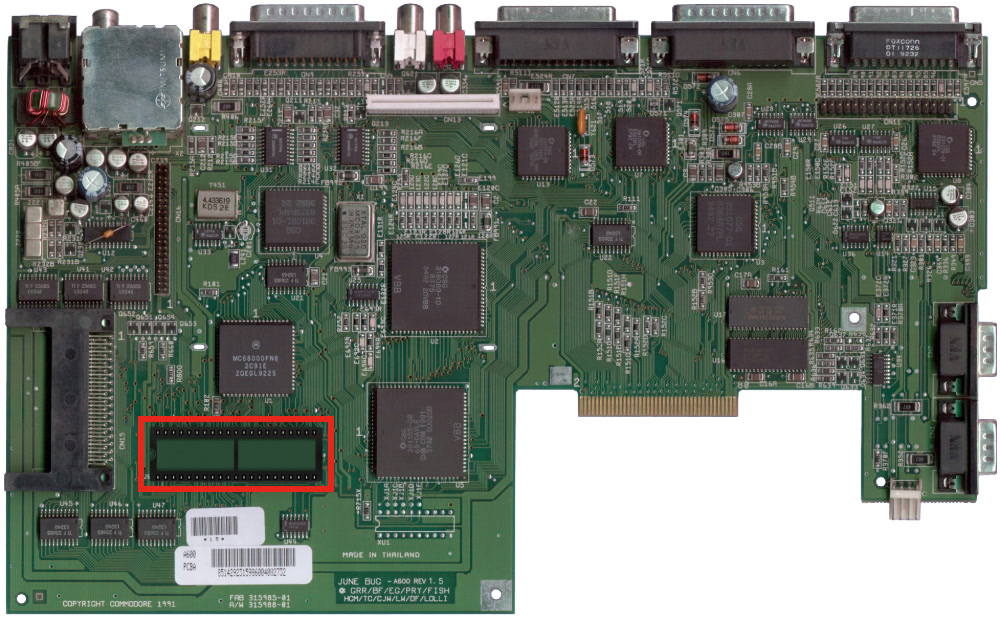
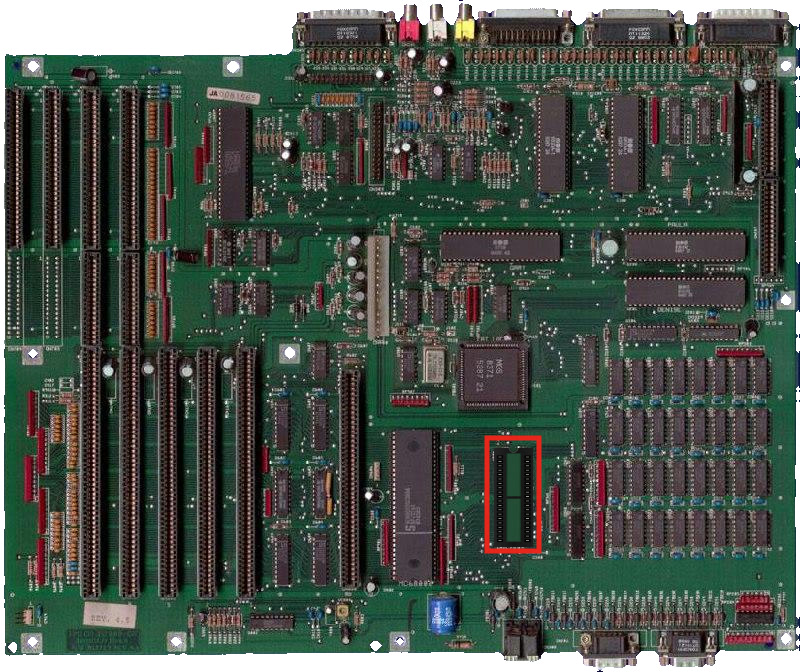
U6) of an Amiga 600 motherboard revision 1.5, boxed in red, with the ROM taken out. Photo: amiga.resource.cx, edited.In the Amiga 2000, the ROM is in the lower half of the motherboard, just to the right of the Motorola 68000 CPU.
By following these instructions, you can safely open your Amiga case and prepare for the hardware installation of the Kickstart Multi ROM.
Unplugging the Amiga ROMs
If the ROM chip is soldered to the motherboard, it is recommended to seek professional assistance to avoid damaging the Amiga. This guide assumes the ROM chip is socketed and can be removed without soldering.
Use a Chip Extractor or Flat-Head Screwdriver
If you have a chip extractor tool, use it to carefully lift the ROM chip out of its socket. If you don’t have a chip extractor, use a flat-head screwdriver. Gently insert the tip under one end of the chip and slowly pry it upward. Repeat on the other end until the chip is free.
Be very careful to lift the chip evenly to avoid bending the pins. Also, avoid using excessive force, as this can damage the chip, the socket, or the motherboard.
Handle ROM Chip with Care
Once removed, place the ROM chip on an anti-static mat or in an anti-static bag to protect it from static damage.
Inspect the Sockets
Inspect the now-empty sockets on the motherboard for any debris or damage. Clean if necessary, using compressed air or a soft brush.
Setting the OOPS Bug jumper
Both the Amiga 500 (rev 5 and older) and the Amiga 2000 (notably rev 4.2 and older) motherboards are affected by the well-known OOPS bug, a hardware routing error in the Kickstart ROM address lines present in early Commodore schematics.
Because of this bug, some replacement Kickstart ROM devices may fail to boot unless compatibility logic is enabled. The carrier board of the Kickstart Multi ROM has an OOPS Bug jumper, so you can enable or disable this compatibility to match your motherboard.
If the jumper is not set properly on affected machines, the Amiga may show a black screen or fail to start after reset.
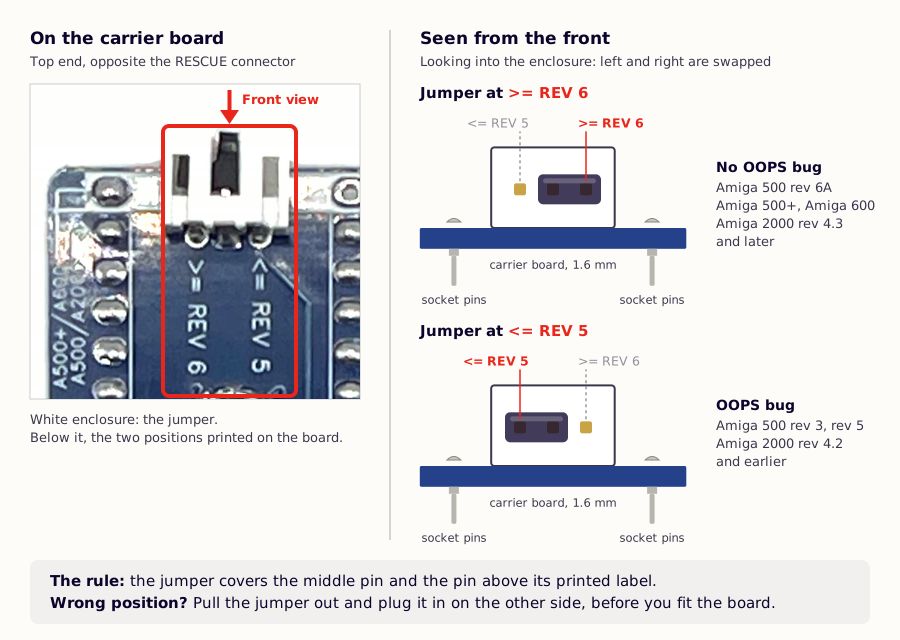
>= REV 6 is on the right and <= REV 5 on the left.Checking the jumper
The jumper sits inside the small white enclosure at the top of the carrier board, at the opposite end from the RESCUE connector. Its two positions are printed on the carrier board below it: >= REV 6 and <= REV 5. Your kit comes with the jumper already set:
- Kit A500 rev 3 and rev 5 / A2000 rev 4.2 or earlier, jumper at
<= REV 5: these motherboards have the OOPS bug. - Kit A500 rev 6 / A2000 rev 4.3 or newer / A500+ / A600, jumper at
>= REV 6: these motherboards do not have the OOPS bug.
Check it against your motherboard in Find your motherboard before you plug the carrier board into the ROM socket.
Ordered the kit for the other motherboards? You do not need another kit. Pull the jumper out of the white enclosure and plug it back in on the other side, the position for your motherboard. Do it before you fit the board: the jumper is harder to reach once the board is in the Amiga.
REV 5 and REV 6 are Amiga 500 motherboard revisions. On an Amiga 2000, go by the list above, not by the number: an Amiga 2000 rev 4.5 does not have the OOPS bug, so its jumper goes to >= REV 6.
After checking the jumper, continue with the normal installation procedure.
Plugging the Kickstart Multi ROM
Depending on the Amiga model, the Kickstart Multi ROM carrier board must be connected to the motherboard in the correct orientation. The following steps provide guidance on connecting the emulator to the Amiga motherboard securely.
Find the Correct Orientation
Amiga 500
Before inserting the board, make sure the OOPS Bug jumper is set correctly for your motherboard (see Setting the OOPS Bug jumper above).
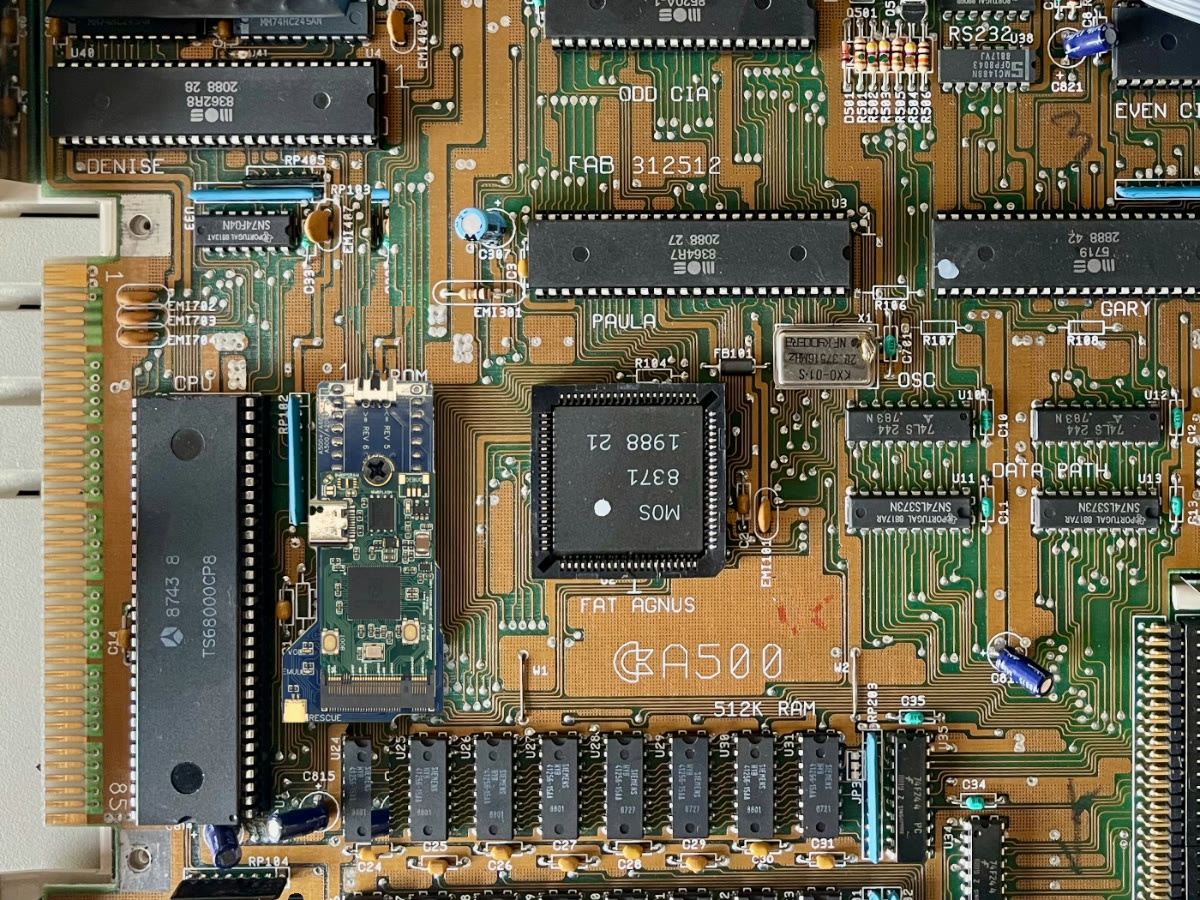
On the Amiga 500, the ROM socket stands between the CPU and the AGNUS chip, with its notch and pin 1 at the top, towards the back of the computer. It has 40 pins. Plug the carrier board in with its top, the end with the white jumper enclosure, at the notch, and the pin with the triangle mark (A500/A2000) in pin 1: the top left pin stays in the air above the socket (40-pin and 42-pin sockets). The ROM Emulator board then lies over the socket, with its USB-C connector towards the CPU and the RESCUE connector at the bottom left.
Amiga 2000
The carrier board plugs into the Kickstart ROM socket on the motherboard. Before inserting the board, make sure the OOPS Bug jumper is set correctly for your motherboard (see Setting the OOPS Bug jumper above).
The pin with the triangle mark (A500/A2000) on the carrier board goes into pin 1 of the Kickstart ROM socket on the motherboard. Take a moment to identify pin 1 on the socket (the side of the socket with the notch, typically labelled on the silkscreen) before pressing the board in. The socket has 40 pins, so the top left pin of the carrier stays outside it, in the air (40-pin and 42-pin sockets). No other pin should overhang the socket edges. If the board does not align cleanly, stop and re-check the orientation rather than forcing it.
On the Amiga 2000, the notch of the socket is at the top, as on the Amiga 500, so the carrier board goes in the same way: the jumper end at the notch.
Amiga 500+ and Amiga 600
The same carrier board plugs into the Kickstart ROM socket of the Amiga 500+ and the Amiga 600. Set the OOPS Bug jumper to >= REV 6 first (see Setting the OOPS Bug jumper above), and line up pin 1 of the carrier with the notch of the socket, as on the other models. Their socket has 42 pins, so here the pin with the box mark (A500+/A600), the top left pin of the carrier, goes into pin 1, the hole next to the notch: all 41 pins go in, and only the hole across from pin 1 stays empty (40-pin and 42-pin sockets).
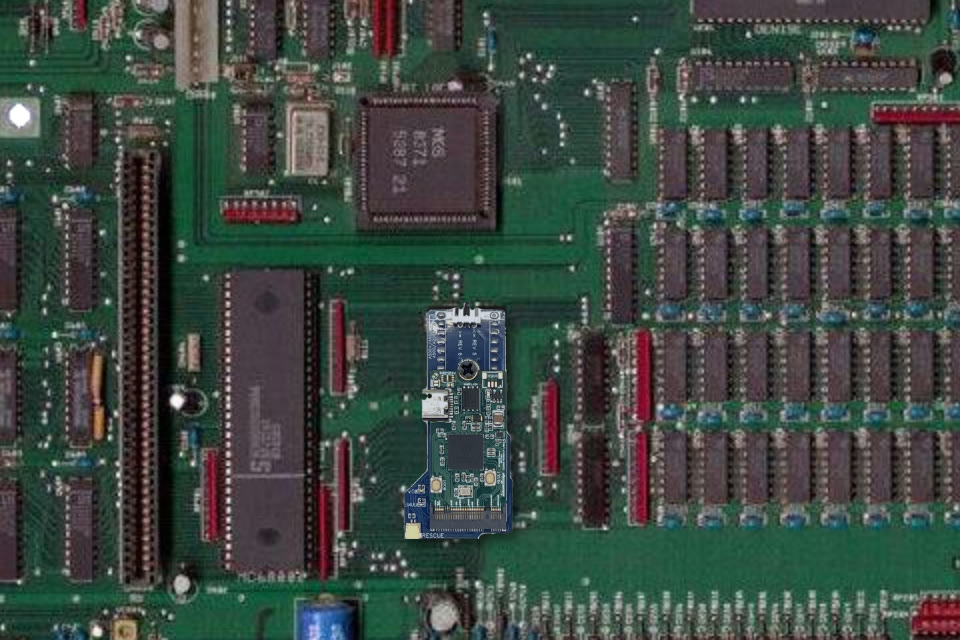
On the Amiga 600, the top of the carrier board, with the white jumper enclosure, points left, towards the PCMCIA slot and the notch of socket U6. The RESCUE connector ends up at the bottom right, next to the Gayle chip.
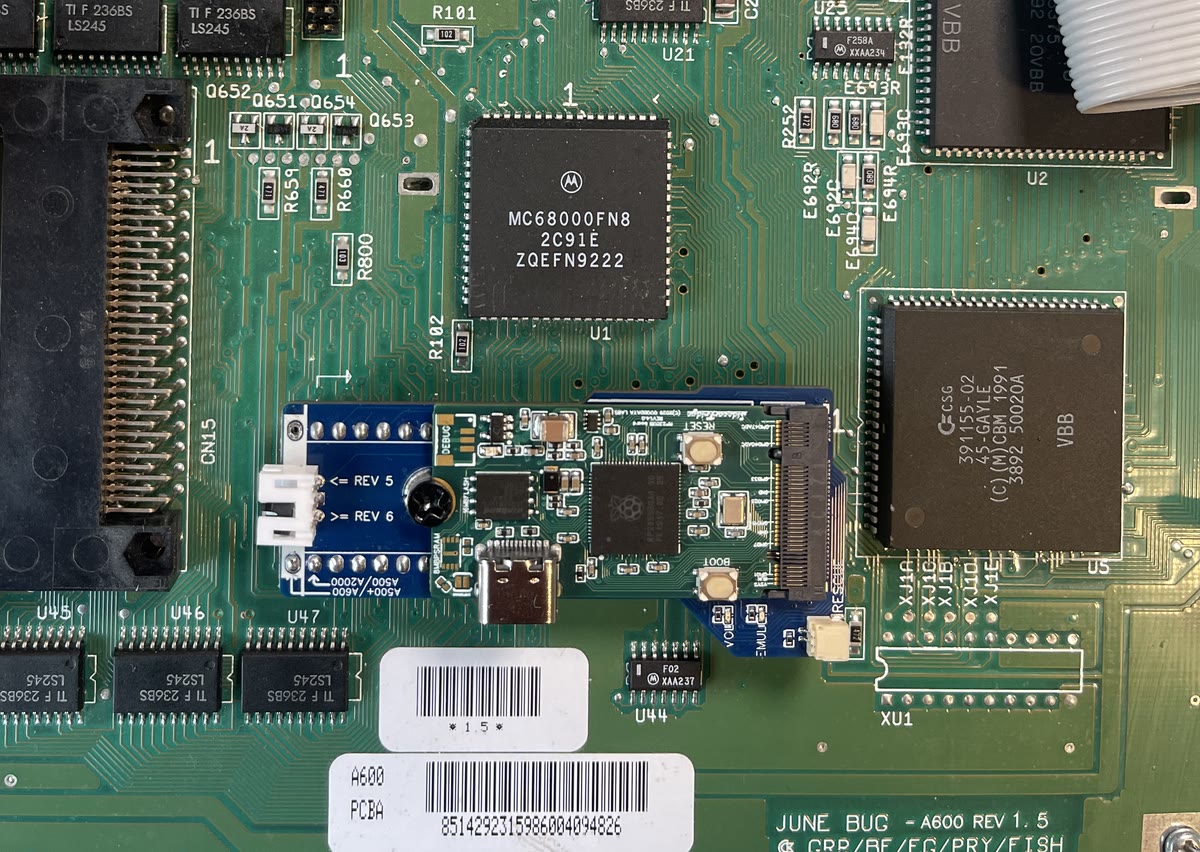
RESCUE connector is at the bottom right.Insert the Kickstart Multi ROM
The carrier board has 41 pins. In the 42-pin socket of the Amiga 500+ and Amiga 600 all of them go in, and the top right hole stays empty. In the 40-pin socket of the Amiga 500 and Amiga 2000, the top left pin, next to the white jumper enclosure, stays outside the socket, in the air. That is expected and does not affect the installation. See 40-pin and 42-pin sockets.
Gently press the Kickstart Multi ROM into the ROM socket. Apply even pressure on both sides to avoid bending any pins. Make sure it is fully seated and secure in the socket. Try to insert all the pins at once, and don’t force it if it doesn’t fit.
The connector pins have some tolerance on purpose. They can flex slightly so they adapt to the position of the socket. A mismatch of about 0.5 mm, and occasionally up to 1 mm, is normal on a machine this old: the socket and the board that holds it have aged and moved. Removing the original Kickstart ROM adds to it. If pulling the old ROM took more force than you expected, that is often not because the IC was seated tightly, but because time has also affected the socket and the surrounding area of the motherboard. Line the pins up with the socket holes before pressing down, and if one of them sits slightly off, bend it gently by hand until it lines up. Never unsolder, resolder or pull out a pin to make it fit.
By following these steps, you will have successfully connected and secured the Kickstart Multi ROM to your Amiga, ensuring a stable and functional installation.
Connect the RESCUE cable
As a final step, connect the RESCUE cable to the white two-pin connector marked RESCUE on the carrier board, in its corner next to the VOL and EMUL LEDs (photo). The Amiga has no RESET button, so the RESCUE button is your only way into rescue mode: do not skip it. Route the cable so it can exit the Amiga case through an available opening (the expansion port area on the Amiga 500, or a free slot opening on the Amiga 2000) so the RESCUE button remains accessible from outside.

Closing the Amiga Case
Test the unit before closing the case
Before reassembling the Amiga, it is recommended to test the unit to ensure the Kickstart Multi ROM is functioning correctly. Power on the Amiga and verify that the Kickstart Multi ROM is recognized and operational.
If the Kickstart Multi ROM is not recognized or functioning correctly, power off the Amiga and recheck the installation steps to identify and resolve any issues. If the problem persists, refer to the Troubleshooting section for further assistance.
Reassemble the Amiga
Once the Kickstart Multi ROM is confirmed to be working correctly, reassemble the Amiga by reversing the steps taken to open the case.
Before closing the case, ensure that no element of the Kickstart Multi ROM is in contact with the metal shielding or any other component that could cause a short circuit.
Insulating tape. Wherever the metal shielding sits very close to the board, put a strip of insulating tape between them to avoid a short circuit.