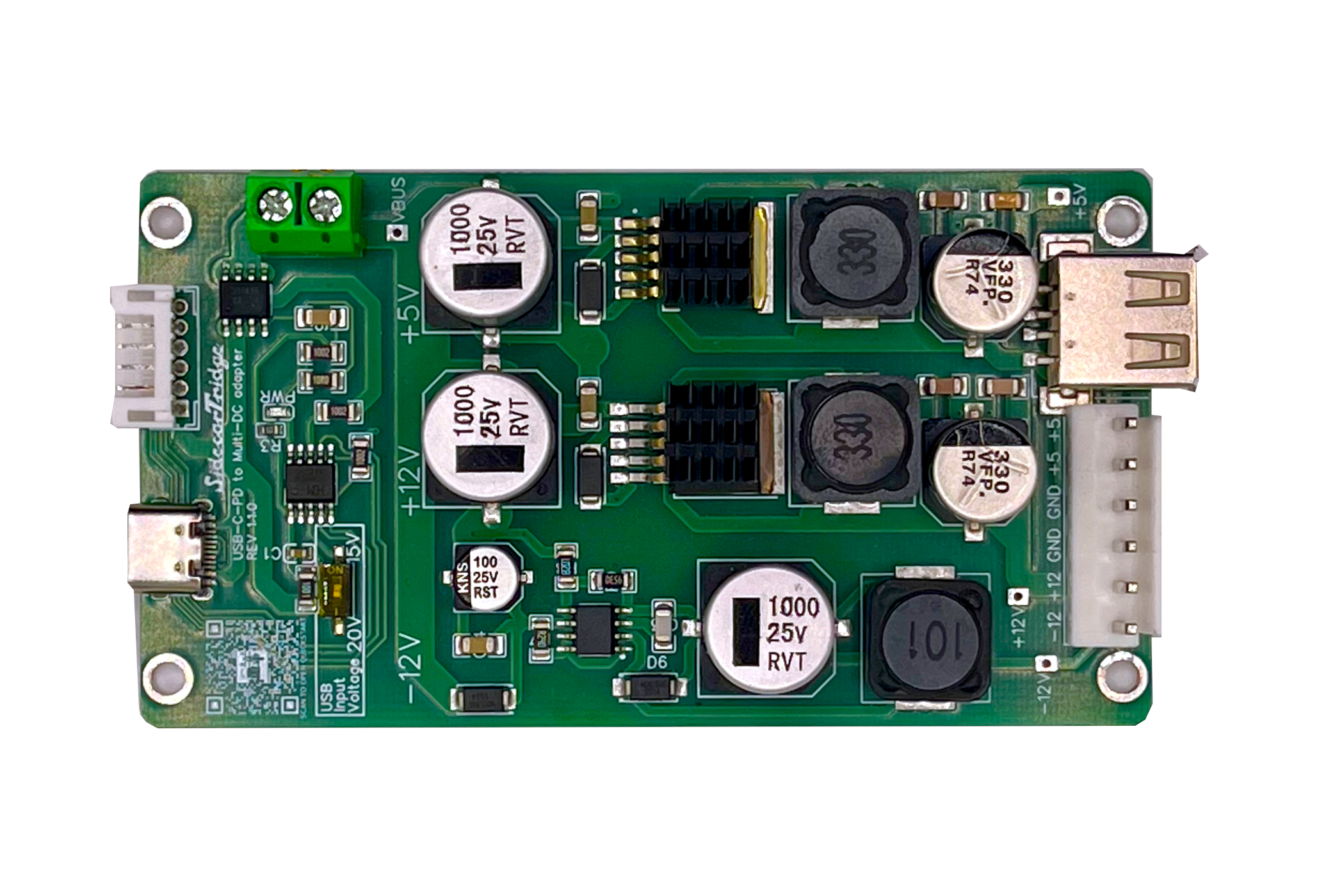
SidecarTridge USB-C PD Multi-Rail Power Supply Unit board
The USB-C PD Multi-Rail Power Supply Unit board
This USB-C Power Delivery multi-rail converter board is designed to generate clean, regulated +5 V, +12 V, and −12 V inside the machine. The output rails can deliver up to 3 A on +5 V, 3 A on +12 V, and 0.3 A on −12 V. It is intended for use in retro computing applications, such as powering vintage computers like the Atari ST/STE/MegaST or Amiga 500 or other electronics projects that require multiple voltage rails.
The board is powered by a USB-C PD charger that must provide either 15 V or 20 V input voltage. It includes overcurrent and thermal protection features to ensure safe operation. The board is compact and easy to integrate into existing systems, making it a convenient solution for powering retro computing devices.
USB-C PD charger requirements
It is important to note that this board is not a standalone power supply and requires an external USB-C PD charger to function.
- Minimum output: 45 W (laptop-class USB-C PD supply)
- Required PD profiles: 15 V and 20 V
- Recommended capability: 15 V 3 A and 20 V 3 A or higher
- Cable: certified USB-C rated 60 W or 100 W
- Multiport chargers must deliver the full wattage on the chosen port
- PD 3.0 is required; QC-only or PPS-only chargers are not supported
List of charger models tested
Warning: Power adapters must be PD 3.0 compliant. Some chargers with PD 3.1 may not work properly—specifically those advertising Extended Power Range (EPR)—even if they claim backwards compatibility with PD 3.0.
| Brand | Model | Output Power | Notes |
|---|---|---|---|
| Anker | A2039 (523-Series) Power Adapter | 47 W | OK. A user reported ghosting issues. |
| Apple | A2166 USB-C Power Adapter | 96 W | OK |
| Apple | A2743 USB-C Power Adapter | 70 W | OK |
| Baseus | GaN PD Power Adapter | 65 W | OK. With STE computers fails to deliver enough power. |
| Baseus | GaN PD Power Adapter | 100 W | OK |
| BIOnd | BGG-GRS-65W Power Adapter | 65 W | OK. Low cost device in GAME stores. It says it has 65W but I doubt (45W?) |
| Dell | LA60NM200 Power Adapter | 60 W | OK |
| Essager | GaN PD Power Adapter | 100 W | OK. Reported ghosting issues. |
| Lenovo | ADLX65YLC3D Power Adapter | 65 W | OK |
| Raspberry Pi | P4123 - 27W USB-C Power Adapter | 27 W | OK with 15V. With STE computers fails to deliver enough power. |
| Raspberry Pi | P5224 - 45W USB-C Power Adapter | 45 W | OK. Cheapest option with remarkable quality. |
How to select the 15 V or 20 V profile
A hardware slider on the top-left corner of the board lets you decide which Power Delivery profile the PSU negotiates. The silk screen labels the two positions “15V” and “20V”; moving the switch forces the controller to request that specific profile from the USB-C charger.
Keep in mind:
- The connected PD charger must support the profile you select. If it lacks the requested 15 V or 20 V mode, negotiation fails.
- When negotiation succeeds, the red status LED in the top-right corner turns on. If the LED stays off, the charger is not delivering the selected profile—switch to the other position or use a compatible adapter.
Selecting the higher 20 V profile is preferred whenever your charger supports it (extra headroom for expansion boards), but either profile is valid as long as the adapter can supply sufficient current.
List of SidecarTridge products using the USB-C PD Multi-Rail board
USB-C PD Multi-Rail PSU Drop-In Replacement Kit for Atari ST/STE/MegaST
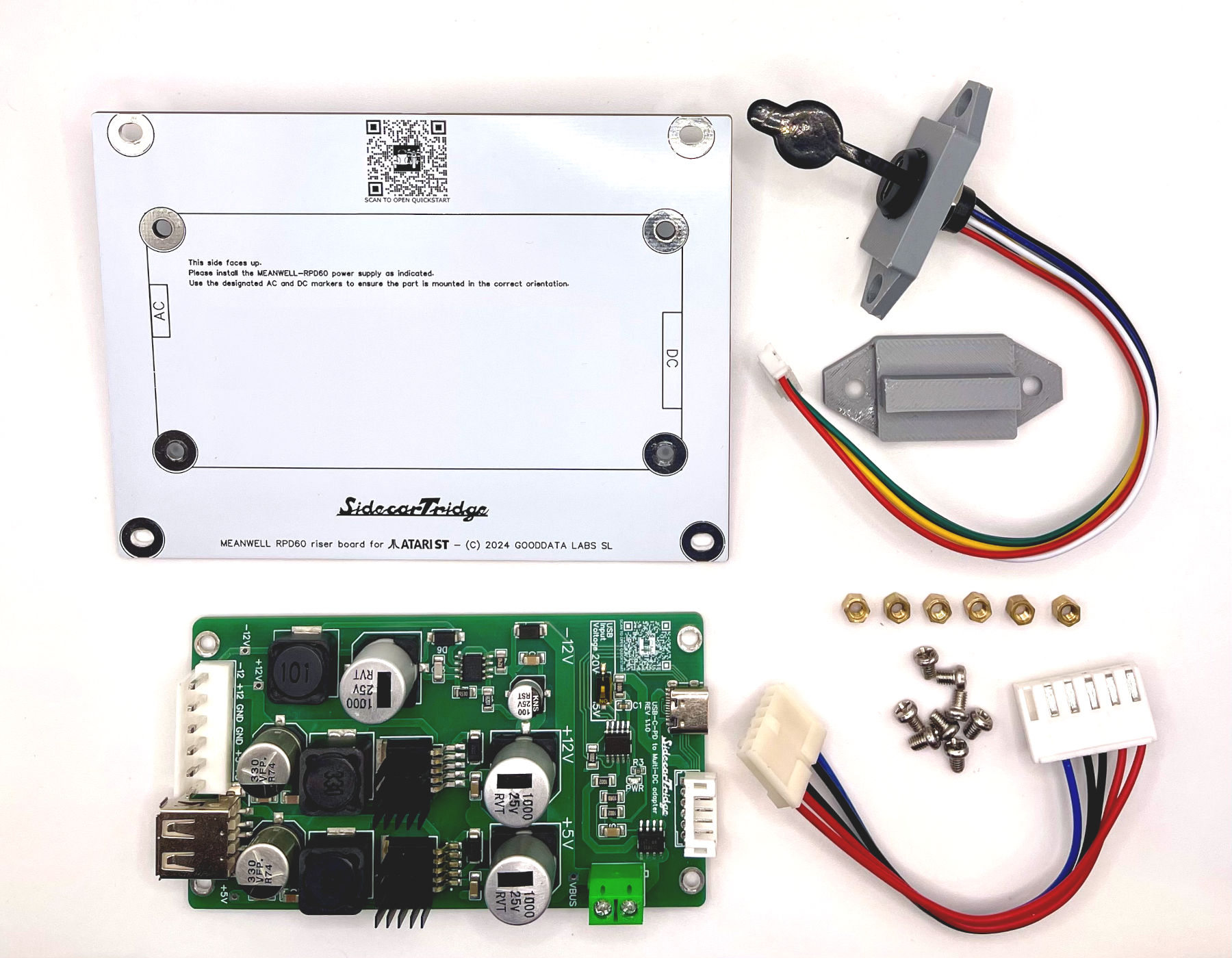
External USB-C PD Multi-Rail PSU + Enclosure + Cable Harness for Atari “short model” ST
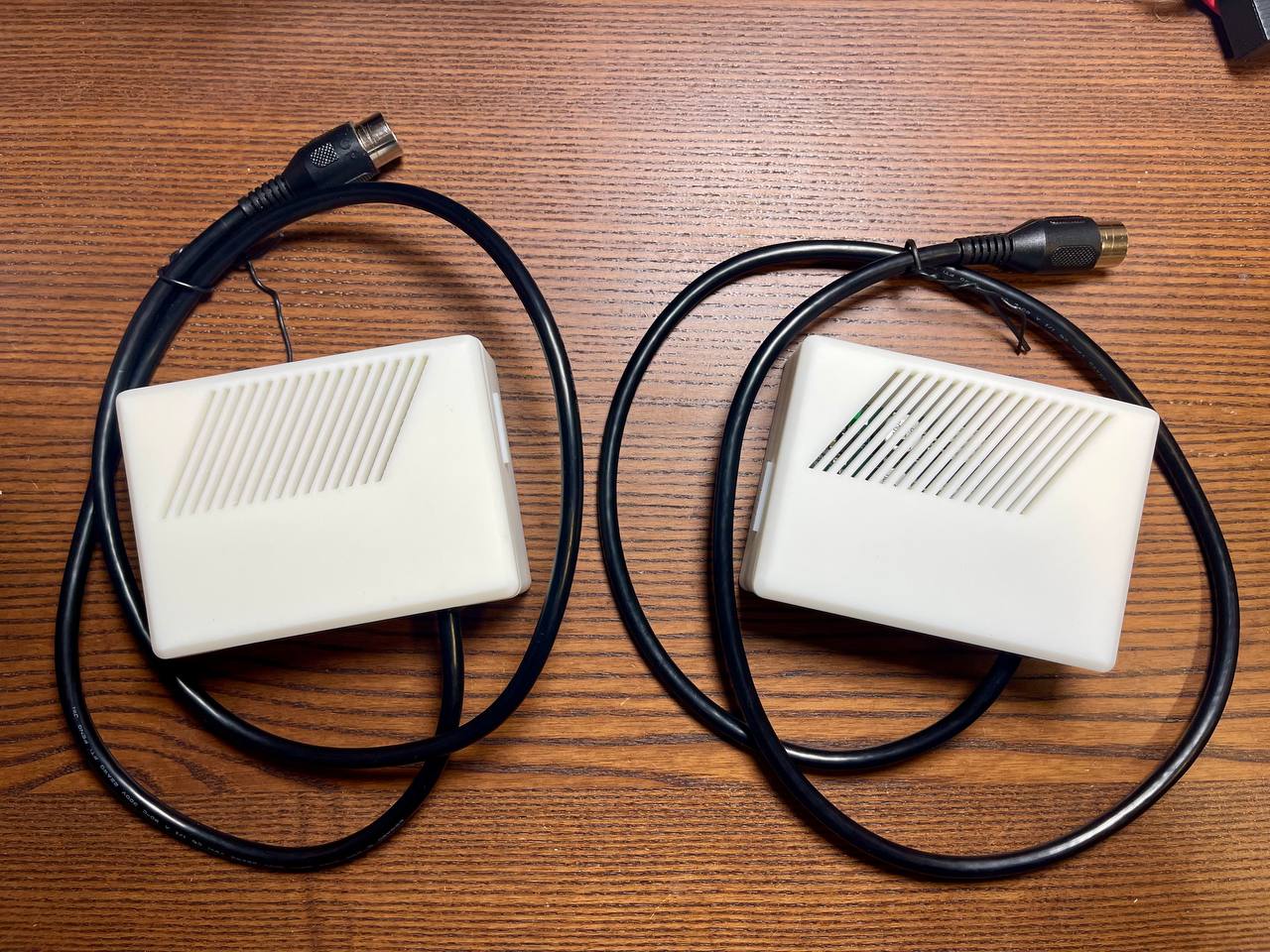
This fully assembled external PSU directly replaces the original 7-pin Atari ST power brick used by the earliest “short” 520ST units. The SidecarTridge USB-C PD multi-rail board is pre-mounted inside a resin enclosure, the harness is professionally crimped with the correct JST-VH and 7-pin DIN connectors, and strain relief is already in place. Plug in a compliant USB-C PD charger, connect the DIN plug to the ST, and power up—no need to open the computer or touch mains voltages.
Key points:
- Single USB-C PD input with independently regulated +5 V/+12 V/−12 V rails sized for the short-model Atari ST mainboard plus SidecarTridge add-ons
- Harness length matched to the short-model ST rear inlet; keeps wiring tidy even on bare chassis
- Includes printed enclosure, internal wiring loom, fasteners, and pre-installed rubber feet—ready out of the box
- Integrated +5 V USB-A auxiliary output for devices such as ACSI2STM, SatanDisk, or Gotek
- Ideal for labs/repairs when you need a safe, swappable supply without reassembling the computer
Charger requirements for the external PSU
- USB-C Power Delivery 3.0 charger supporting both 15 V and 20 V profiles
- 45 W minimum output (60 W+ recommended if you share the brick with other hardware)
- Certified USB-C cable rated for 60 W or 100 W
- Multi-port chargers must be able to deliver the full wattage on the selected port
- QC-only, PPS-only, or proprietary fast-charge standards are not supported
- Some PD 3.1 / EPR chargers can mis-negotiate; stick to the tested adapter list when in doubt
Compatibility
Designed for short 520ST units that shipped with the external 7-pin PSU brick, including motherboards:
- C070115
- C070243
If your ST has an internal PSU (later STF/STE/Mega variants), use the internal drop-in kit instead.
External USB-C PD Multi-Rail PSU + Cable Harness Kit for Atari “short model” ST
Prefer to print your own shell? This version bundles the populated USB-C PD board plus the short-model ST harness and strain-relief hardware, letting you reuse an enclosure of your choice.
- Ships with the same wiring loom and rubber grommet as the pre-built external unit
- Download the enclosure STL from the product page (or remix your own); the design uses standard M3 machine screws and nuts to clamp the two halves together
- Recommended hardware: four M3 × 12 mm pan-head screws with matching M3 hex nuts for the enclosure, plus two M2.5 × 10 mm self-tapping screws for the cable clamp
- Perfect if you already have a 3D printer or want to match a custom color/finish
Both external options rely on the same USB-C PD charger requirements listed above, so you can share a single high-quality PD brick across multiple Atari systems.